

For years, heat safety in the American workplace was governed by the General Duty Clause. It was the "it’s the thought that counts" of safety regulations - a vague requirement for employers to provide a workplace "free from recognized hazards." If a worker suffered from heatstroke, OSHA would point to the clause and say, "You should have known better."
In 2026, the era of "should have known" will officially be over. The transition from voluntary recommendations to the mandatory Heat Illness and Injury Prevention Plan (HIIP) will represent the most significant shift in federal safety standards in a generation. If you’re still relying on a cooler of lukewarm water and a "take a break if you need it" policy, you won't just be behind the curve - you’ll be out of compliance.
The final rule is still pending, but enforcement around heat exposure has not slowed. OSHA's Heat National Emphasis Program was updated on April 10, 2026 and will remain in effect for the next 5 years, which means inspectors are already evaluating heat risks during site visits under existing OSHA regulations. If you're not in compliance, you can be cited under the General Duty Clause.
The Core Mandate: The HIIP Plan
The centerpiece of the new standard is the Heat Illness and Injury Prevention Plan (HIIP). Unlike previous guidance, this isn't a suggestion; it is a programmatic requirement.
-
Who needs it? Every employer with a "reasonable expectation" of heat exposure must have one.
-
The Written Requirement: If you have more than 10 employees, your HIIP must be a written document accessible to all workers.
-
The Heat Safety Coordinator: You are now required to designate a specific person to oversee the plan. This isn't just a title - they must have the authority to enforce compliance on-site.
Note: The HIIP must be developed with input from non-managerial employees. OSHA is making it clear: the people feeling the heat need to have a seat at the table when the cooling plan is built.
Monitoring the Triggers: 80°F and 90°F
Under the new 2026 updates to OSHA 29 CFR 1910 (General Industry) and 1926 (Construction), compliance is no longer based on "how hot it feels." It is based on specific, measurable triggers using the Heat Index.
The Initial Heat Trigger: 80°F
When the heat index hits 80°F, the following mandatory controls kick in:
-
Hydration: At least 1 quart of "suitably cool" water per employee, per hour.
-
Shade/Cooling: Accessible break areas with shade or air conditioning.
-
Acclimatization: A strict schedule for new or returning workers (who have been away for 14+ days) to gradually increase their exposure.
The High Heat Trigger: 90°F
Once the mercury hits 90°F, the "High Heat" procedures are activated:
-
Mandatory Breaks: A minimum of one 15-minute paid rest break every two hours.
-
Observation: Employers must implement a "buddy system" or supervisor observation to catch early signs of heat illness.
-
Hazard Alerts: Pre-shift alerts must be sent to all employees reminding them of the risks and their rights to water and rest.
Construction and the ANSI/ASSP A10.50-2024 Standard
For those in construction and demolition, the ANSI/ASSP A10.50-2024 standard has become the "gold standard" for OSHA compliance. While OSHA provides the legal floor, the A10.50 standard provides the ceiling for best practices.
The 2026 OSHA updates specifically align with this standard's focus on Task-Based Heat Risk Assessments. This means before a high-exertion task (like roofing or asphalt paving) begins, a "Competent Person" must evaluate the micro-climate of that specific job site, accounting for radiant heat and PPE-induced heat retention.
Myth Busted: "It’s Only for Outdoor Workers"
One of the most dangerous misconceptions about the 2026 standard is that it only applies to those working under the sun. This is false.
The new regulations place a heavy emphasis on indoor manufacturing environments. In facilities where "process heat" is present - think industrial ovens, furnaces, or glass manufacturing—the ambient temperature might be 75°F, but the work zone could be 100°F.
-
Micro-Climates: Employers must now identify specific indoor areas where the heat index might reach the 80°F trigger.
-
The 120°F Rule: Any indoor area that regularly exceeds 120°F ambient temperature now requires permanent, visible warning signs.
-
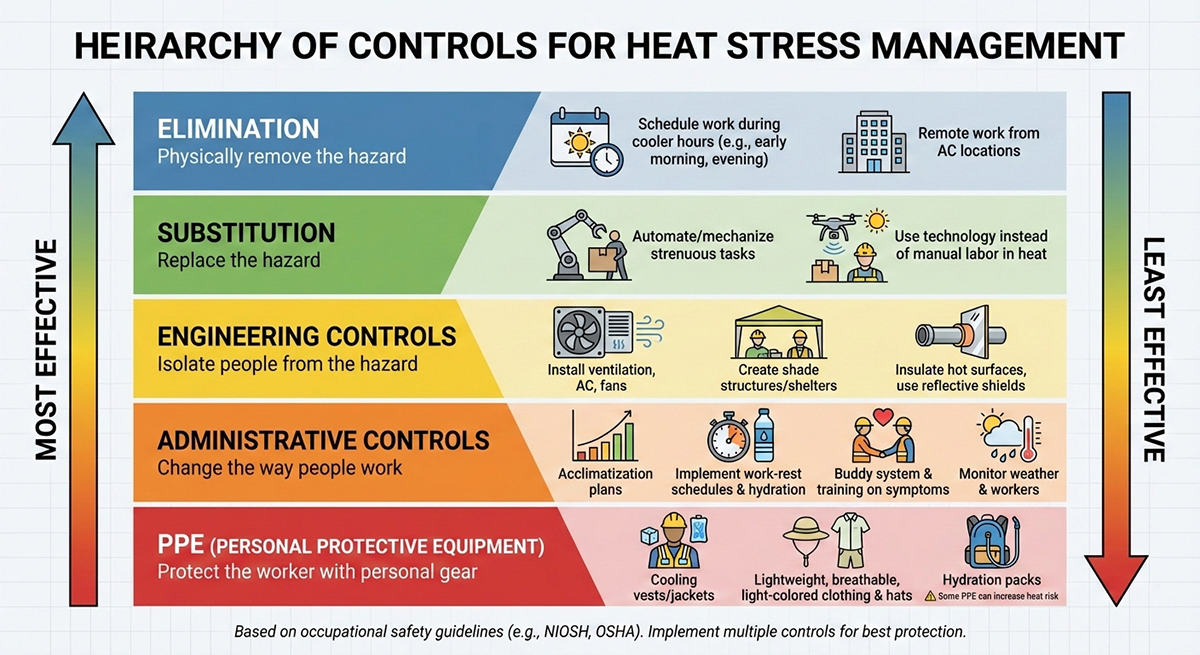
Engineering Controls: If you operate a facility with process heat, OSHA now expects to see localized exhaust ventilation, reflective shielding, or cooled "rest cabins" as part of your HIIP.
Final Thoughts
The 2026 OSHA Heat Standard is more than just a new set of rules; it’s a shift in how we value worker health in a warming world. Compliance is no longer about reacting to an emergency - it's about the proactive, data-driven management of environmental risk.
goSafe offers a wide variety of Seasonal PPE that is customizable on-site by our Customization Department. Our wide selection of Warm Weather PPE ensures that you'll be equipped to ward off the heat - and still get the job done safely. We also maintain a constant, ready-to-ship supply of FR Clothing and Safety Footwear in our 'Core FR' department. For more information on these products or any of our other safety and PPE products, please contact us at sales@gosafe.com.
goSafe: Your Partner in Safety
At goSafe, Safety is our ONLY focus - and we'll partner with you to keep you and your teams safe. We're small enough to handle your local projects, yet large enough to serve national accounts. If safety is your mission, it starts with us.
Watch the video below for more information about goSafe's capabilities.