

In the high-stakes world of fall protection, the difference between "getting the job done" and "getting the job done safely" often comes down to a single, critical misapprehension: the assumption that all Self-Retracting Lifelines (SRLs) are created equal.
If you are working on a leading edge - a horizontal surface where a fall could cause your lifeline to traverse over a sharp, abrasive, or unprotected edge - using a standard SRL is not just a policy violation; it is a profound safety oversight. To understand why, we have to look past the marketing and into the physics of fall dynamics.
The Physics of the Edge
When a worker falls from a standard vertical position while anchored overhead, the SRL is designed to lock and arrest the fall in a controlled manner. However, when working over a leading edge, the geometry of the fall changes entirely.
-
The Severing Risk: A standard SRL lifeline - often made of wire rope or synthetic webbing - is not engineered to maintain its structural integrity when dragged across a steel beam, concrete corner, or corrugated metal edge under the extreme tension of a fall. The friction and force of a drop against a sharp edge can slice through a non-rated lifeline like a knife through soft material.
-
Swing-Fall Dynamics: Working near an edge introduces the "pendulum effect." If a worker falls to the side of their anchor point, the lifeline moves across the edge. This lateral movement increases the total fall distance, increases the impact force on the body, and subjects the lifeline to severe friction against the edge material. Standard devices are neither tested nor built to survive this combination of tension and abrasion.
ANSI Z359.14: The Gold Standard
To address these life-threatening gaps, the industry adheres to ANSI Z359.14. This standard introduced rigorous testing specifically for designed to evaluate performance for devices subjected to falls over a "Leading Edge".
A Class 2 device undergoes intense drop testing over a simulated steel edge with no burrs or rounding. Unlike standard devices, Class 2 units are engineered with higher tensile strength materials and specialized designs that allow the lifeline to maintain integrity even when subjected to the extreme forces of a dynamic fall over a sharp corner.
How to Identify a Class 2 Rated Device
Never assume a device is Class 2 rated just because it "looks" heavy-duty. Always check the label.
-
Look for the Markings: An ANSI-compliant Class 2 device will clearly state that it is rated for leading edge use, accompanied by a specific icon. If you cannot find this explicit designation on the manufacturer’s label*, the device is not tested for edge hazards.
-
The Shock Absorber is Non-Negotiable: This is the most critical feature. Standard SRLs typically have internal braking mechanisms. However, an LE-rated device must incorporate an integrated shock absorber - often located at the connector end (near the body) - specifically designed to mitigate the forces generated by a fall over an edge.
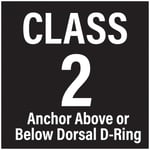
*Example of Manufacturer's Class 2 Label
Because the fall distance is often greater when working near an edge, the shock absorber is essential to ensure that the impact forces transmitted to the worker’s body stay within safe, survivable limits. Without this specialized, external shock absorber, the arresting forces can be dangerously high, leading to catastrophic injury even if the lifeline doesn't sever.
The Bottom Line
When working on leading edges, standard SRLs offer a false sense of security. They are designed for vertical anchorages, not for the harsh, abrasive realities of edge work.
The takeaway is simple: If your work environment involves potential contact with a sharp edge, you must use equipment specifically certified to ANSI Z359.14 Class 2 requirements. Check your gear, confirm the rating, and ensure that the shock absorber is present and intact. When the stakes are this high, the distinction between standard and LE isn't just about compliance - it’s about coming home at the end of the day.
For more information on Fall Protection, CLICK HERE to visit our Fall Protection FAQ. goSafe offers a complete selection of Fall Protection and Horizontal Lifeline Systems. We also operate an onsite Customization Department that can customize many PPE items with your company logo. goSafe maintains a constant, ready-to-ship supply of FR Clothing and Safety Footwear, and also partners with Bollé Safety in their Seamless Vision Prescription Safety Eyewear Program. For more information on these products and services or any of our other safety and PPE products, please contact us at sales@gosafe.com.
goSafe: Your Partner in Safety
At goSafe, Safety is our ONLY focus - and we'll partner with you to keep you and your teams safe. We're small enough to handle your local projects, yet large enough to serve national accounts. If safety is your mission, it starts with us.
Watch the video below for more information about goSafe's capabilities.